# Rangeviewr
> All you need to crush Spin & Go
The fastest and cheapest preflop solver for Spin and Go. GTO library, instant push strategies, nodelock and preflop trainer in one tool. Start for free.
Short index: https://rangeviewr.com/llms.txt
---
# All In Trainer: Drill Your Calls at Random Stacks
URL: https://rangeviewr.com/blog/all-in-trainer
Published: 2026-11-14
Updated: 2026-11-14
**TL;DR**
- The new All in trainer drills only shove, call and fold spots. Every hand has its own random stack, to the tenth of a big blind, up to a cap you set.
- A call has to be automatic. On eight tables you have no time to think, and only reps put the answer in your head.
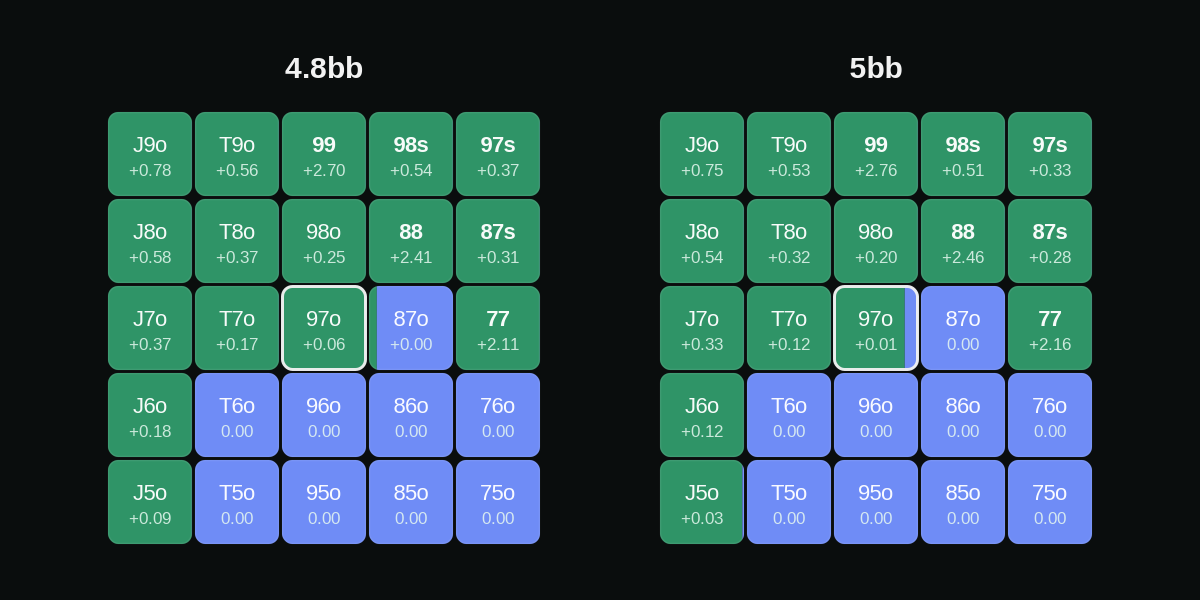
- Details are worth chips: 97o facing a jam is a call worth +0.061bb at 4.8bb and a losing call (-0.019bb) at 5.2bb.
The All in tab trains one skill: knowing what to call, fast. No limps, no raises, no postflop. You get a hand, a stack like 6.7bb, and a jam. Call or fold.
## Why calls have to be automatic
On four tables, you can still think about a call. On eight, you do not have time anymore. That is why call decisions, which matter so much, must be automatic.
The only way to answer in a few seconds is to already know the answer. Knowing comes from reps, not from reading a chart once.
And even then, knowing round stacks is not enough. In real games you face decisions at 4.8bb, 6.7bb, 9.3bb... And the call range changes a lot between them. Look at 97o in the big blind, facing a jam:
## How it works
- Pick heads-up or 3-way, then a max stack: 5, 8, 12, 15, 20 or 25bb.
- Each hand draws its own stack between 2bb and your cap, to the tenth. With a cap of 8 you get 5.2bb, 6.7bb, 2.2bb.
- Heads-up, you play the small blind (jam or fold) and the big blind (call or fold). In 3-way, you play the button, the small blind and the big blind, including the calls that come after another player jammed.
- You answer, and the solver replies with its mix and the EV you lost on the hand. Keyboard shortcuts let you answer without the mouse.
## 97o: a tenth of a big blind changes the answer
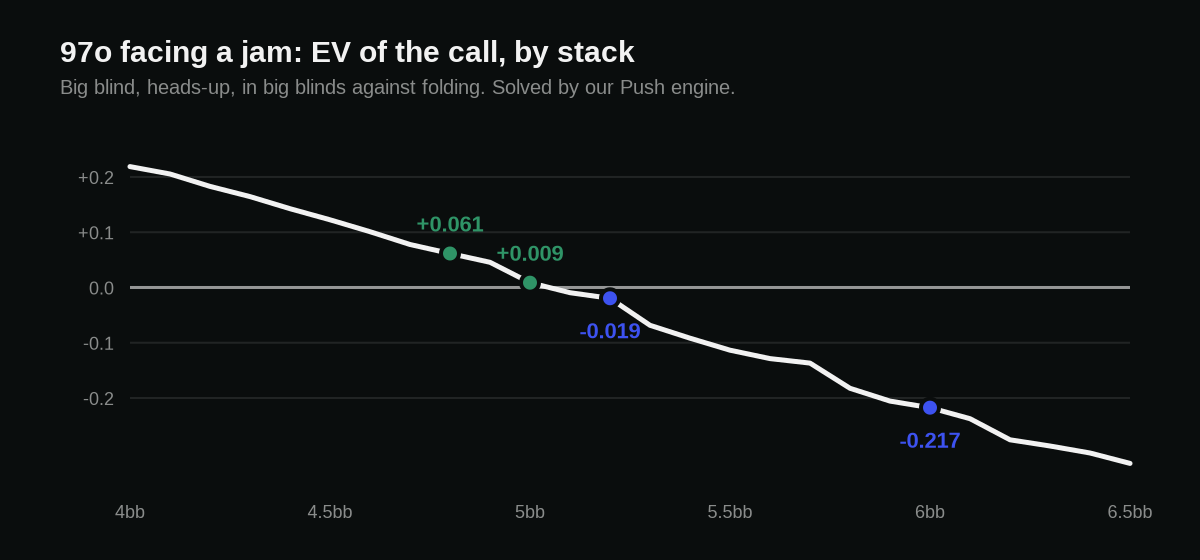
Take 97o in the big blind, facing a small blind jam, heads-up. Here is the EV of the call, in big blinds, against folding:
| Stack | EV of calling 97o | Solver calls |
|---|---|---|
| 4.5bb | +0.122 | 100% |
| 4.8bb | +0.061 | 99% |
| 5.0bb | +0.009 | 84% |
| 5.2bb | -0.019 | 0% |
| 6.0bb | -0.217 | 0% |
At 4.8bb the call earns +0.061bb. At 5.0bb it is close to zero and the solver mixes. From 5.1bb it folds. Call it at 6bb and you give up 0.217bb. Same hand, same opponent, one big blind of difference.
## Small leaks compound
Minor details like that compound. It is a lot of EV, on a lot of $$$.
Want to see how many of your calls are automatic? [Start free](/#pricing) (no card, ofc) and open the Trainer's All in tab.
---
# The Fastest and Cheapest Preflop Solver
URL: https://rangeviewr.com/blog/rangeviewr-2-0
Published: 2026-11-13
Updated: 2026-11-13
**TL;DR**
- 2.0 adds a full preflop solver: with Push/fold strategies solve instantly and nodelock feature.
- It works heads-up and 3-way, runs in your browser, and costs $19 a month after a 7 day trial.
- It is built for Spin and Go only. If you need postflop trees or full tournament ICM, use a general solver next to it.
Rangeviewr 2.0 is the fastest and cheapest preflop solver on the market. You can study, compare, run and train everything on the same tool.

## What is new
Three modes now sit in the navbar.
| Mode | What it does | Heads-up | 3-way |
|---|---|---|---|
| **GTO** | The solved library you already know, Classic and FGS | Yes | Yes |
| **Push** | Exact shove or fold solve at any depth from 1bb to 25bb | Yes | Yes |
| **Nodelock** | Edit a spot, lock a strategy, get the best reply | Yes | Yes |
### Push: any depth, instantly
PUSH runs the shove or fold game super fast, so you can study calling ranges for every stack depth, from 1 to 25 bbs. With every minor details even at 6.4 bbs.
We comapred our model against HRC exports. Heads-up push and fold trees match within ~1.6 points.
### Nodelock: use the tendencies you know
Take any spot in the tree and change it. Add a limping strategy, change sizings a twist the range from a Nit, Aggressive or Whale perspective.
- **Brush** a hand class and set the action and the weight, from 5% to 100%.
- **Presets** for the three players you actually meet: Nit, Aggro and Whale. Aggro plays the close hands as raises or jams, Nit plays them passively, Whale just plays too much.
- **Re-solve** in about half a second heads-up. 3-way takes 15 to 30 seconds, because three players make the math much heavier.
- **Save** the result into a custom folder, for example "vs Nits", and open it later in the Library.
### Live preflop coaching
A coach can host a session within Rangeviewr. The coach's mode and spot update on the student's screen, and the student's browser solves it locally. Everything can be saved and shared.
### Smaller things
- Custom folders to sort your saved ranges.
- The action tree now names the acting seat on every row.
- A quieter solve indicator.
## How it compares
Prices are public and change often. HRC's come from its pricing page, GTO Wizard's from a March 2026 PokerNews report, both read on 13 November 2026. Yearly plans cost less, so check each tool's own page before you decide.
| |  Rangeviewr |
 HRC |
 GTO Wizard |
|---|---|---|---|
| Built only for Spin and Go | Yes | No, it covers many formats | No |
| Push at every depth, instant | Yes | Partial: you build and solve it yourself | Partial: varies by tool |
| Ready library plus trainer in one app | Yes | Yes, library and trainer exist | Yes |
| Archetype presets (Nit, Aggro, Whale) | Yes | Partial: you set them up by hand | Partial: varies |
| Import your own HRC exports | Yes | Yes, native | Partial: not the same format |
| Postflop solving | No | Partial: limited | Yes, often their main product |
| Full tournament ICM | No | Yes | Yes |
| Price | $19 a month, 7 day trial | [$16.66 to $49.99 a month](https://www.holdemresources.net/hrc/pricing) | [$49 to $169 a month](https://www.pokernews.com/news/2026/03/gto-wizard-subscription-plans-new-features-pricing-50908.htm) (Starter to Elite, billed monthly), Ultra costs more |
YesYesPartialPartial or dependsNoNo
Where we are stronger: focus. Every screen is a Spin and Go screen, and the question "what should the small blind do at 7bb 3-way" is two clicks away.
Where we are weaker, and you should know it:
- **No postflop.** Rangeviewr is preflop only.
- **No ICM engine.** Most Spins are winner take all, so this matters less here. For other formats, use another tool. (maybe it's coming next?)
## Try it
```steps
target | **Open Push.** choose the format, the seat and the stack depth.
lock | **Open Nodelock.** Apply a nitty tendency and everything adapt to it.
folder | **Save it.** Put it in a custom folder and drill it in the Trainer.
```
[Start free](/#pricing), no card. Pro includes the engine. Want the starting ranges first? See [Spin and Go ranges by stack depth](/spin-and-go-ranges) and the [Spin and Go trainer](/spin-and-go-trainer).
## FAQ
### Is Rangeviewr 2.0 a solver?
It has a preflop solver for Spin and Go that runs in your browser. It does not solve postflop.
### Do I need HRC to use it?
No. The library is ready to use. HRC exports are only needed if you want to import your own ranges.
### Are the Push ranges what I should play at 20bb?
Push shows the best pure shove or fold play. At 20bb real play also includes raises, so use the GTO library for the full picture and Push to study calling ranges.
### Will it make me win more?
Yes indeed. Preflop is the cornerstone of Spin and Go, everyone mastering the preflop game automatically increases his earnings.
---
# FGS Ranges for Spin & Gos
URL: https://rangeviewr.com/blog/spin-and-go-fgs-ranges
Published: 2026-11-01
Updated: 2026-11-05
**TL;DR**
- Classic ranges assume the game ends with the hand which obviously doesn't.
- FGS ranges start to matter below 10bb, when every blind you lose has a real impact to your stack.
Every Spin and Go ranges you'll find out there assume that the game ends after you played the hand. Which is fine at 25bb but pretty weird at 5bb deep. Like in a Turbo, 3-way format future game has a real impact. We solved both versions and put them side by side, so you can compare and see differences.
## Each orbit costs a lot
Imagine, eacch orbit you lose 1.5bb and you play in a 3-way turbo format, how fast you think you'll blidn out?
| Your stack | Next big blind | Next full orbit |
|---|---|---|
| 25bb | 4% | 6% |
| 10bb | 10% | 15% |
| 7bb | 14% | 21% |
| 5bb | 20% | 30% |
| 4bb | 25% | 37.5% |
No matter what you'll hit the big blind next.
Now add the clock to that. PokerStars [a level every 2 to 5 minutes](https://www.pokernews.com/strategy/spin-and-go-poker-36231.htm). Winamax Expresso moves [every 90 seconds](https://www.cardplayer.com/fr/poker-en-ligne/expresso-poker). Fold at 5bb deep and you'll not keep them like classic ranges presume.
## What FGS is, and who already has it
FGS is not new and we didn't invent it. [PokerStrategy describes it](https://www.pokerstrategy.com/strategy/sit-and-go/2380/1/) as a look ahead that adds the value of future options. [ICMIZER](https://icmizer.com/en/blog/how-fgs-future-game-simulation-calculator-works) and HRC both compute it.
We found no public Spin and Go chart that uses a future game model, [poker.academy](https://poker.academy/preflop-charts) and [GTO Ranges+](https://apps.apple.com/us/app/gto-ranges-poker-solver/id6458732631) included (checked November 2026).
So you have two choice - either solve it by yourself or take a look at Rangeviewr ones for free.
Get the ranges for free
What our two sets model:
- **Classic** is a chip EV model. The hand ends.
- **FGS** is a future game simulation model with a winner take all prize. Accounting for depth 3, and depth 1 when three players are left.
## Heads-up: it barely changes before 5bb
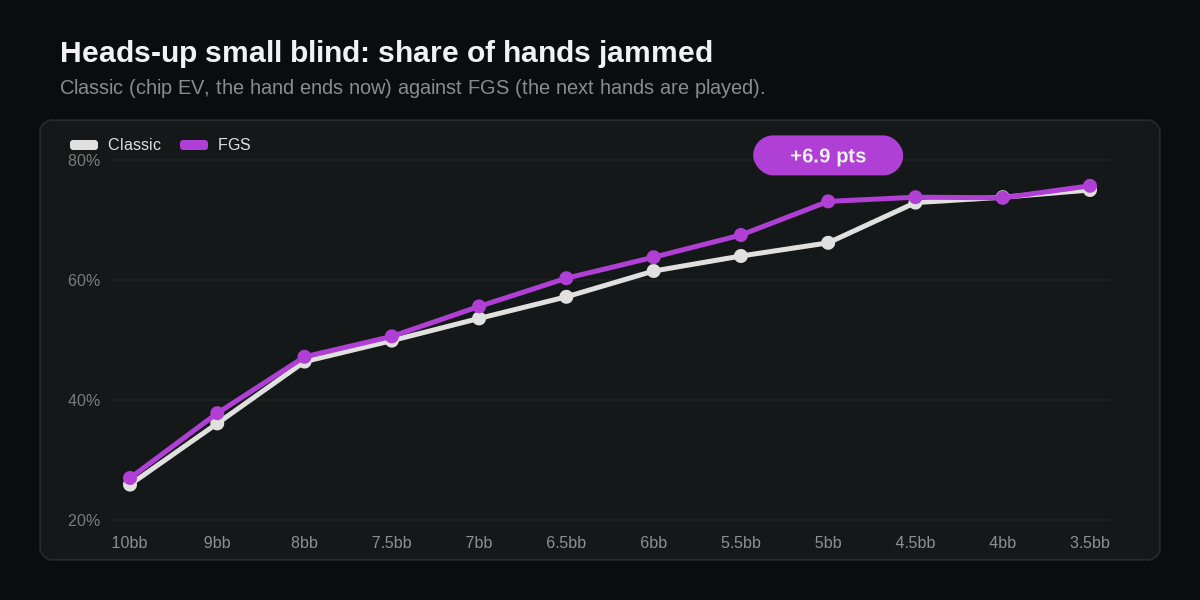
The heads-up small blind jams a bit more in FGS at nearly every depth, and most gaps are under 3.5 points. The big one is 5bb: 66.2% against 73.1%.
The caller barely reacts. The big blind's call against a jam stays within 0.6 points from 10bb down to 4.5bb, and only reaches 1.6 at 4bb.
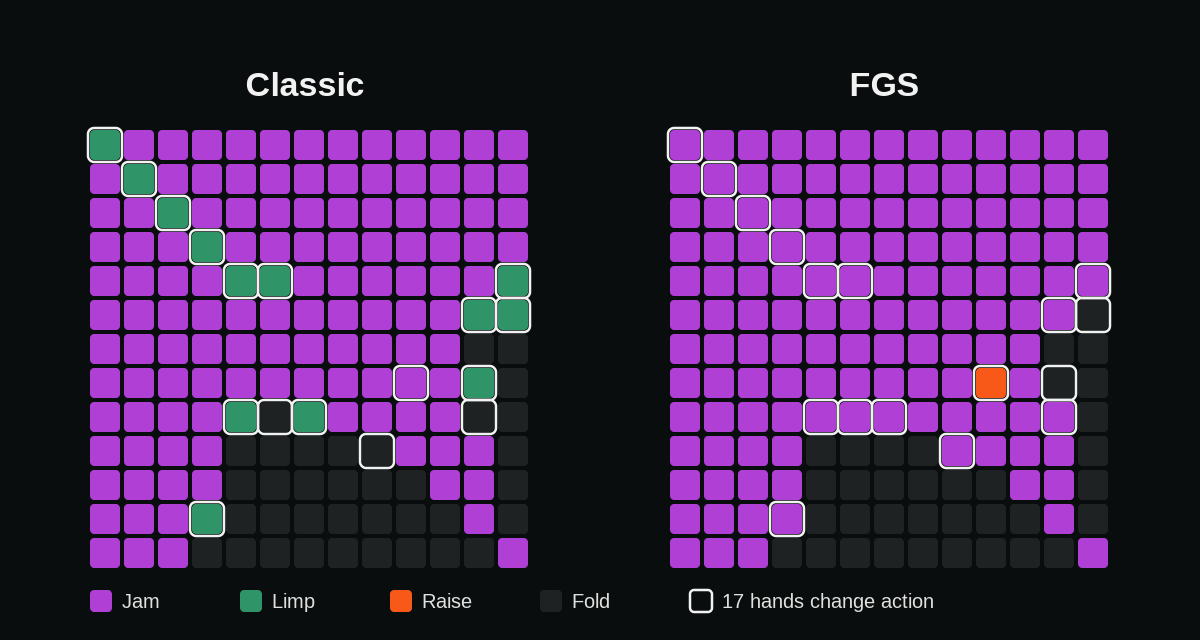
Same 5bb spot, hand by hand. Classic limps AA, KK, QQ, JJ and TT most of the time. FGS jams all of them. Part of that gap comes from the two trees using different bet sizes, so read the jam and call spots first and take the limp lines with a grain of salt.
## Three-way: here come the real differences
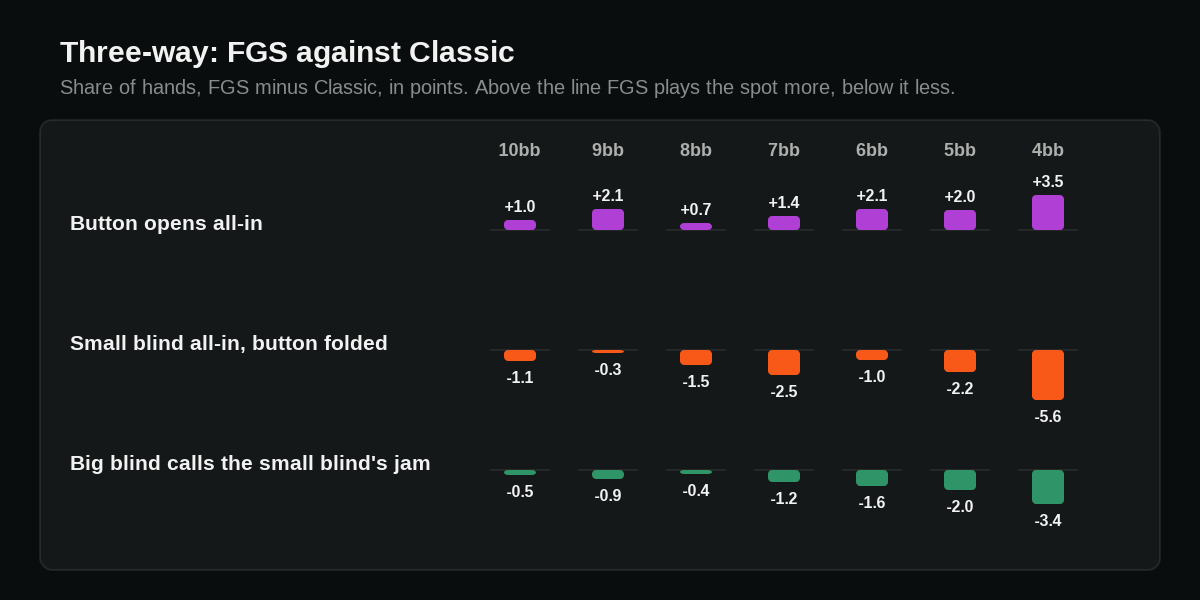
| | 10bb Classic | 10bb FGS | 7bb Classic | 7bb FGS | 4bb Classic | 4bb FGS |
|---|---|---|---|---|---|---|
| Button opens all-in | 27.3% | 28.3% | 36.8% | 38.2% | 42.0% | 45.5% |
| Small blind all-in, button folded | 43.7% | 42.6% | 59.7% | 57.2% | 72.8% | 67.2% |
| Big blind calls the small blind's jam | 36.7% | 36.2% | 48.1% | 46.9% | 70.7% | 67.3% |
As stacks shrink, the button jams more while the small blind jams less and the big blind calls less. One fixed "short stack" adjustment gets at least one of these seats wrong. (that's the punt.)
## The real imapct occurs below 10bb
This is where each blind has a real impact on your stack.
That's why our FGS library stops at 10bb. We haven't implemented FGS ranegs above that 'cause they were urelevant. The logic is simple though: at 25bb the next big blind is 4% of your stack, and there's not much future cost.
## How to use it
```steps
split | **Open the same spot in both.** In the Library, switch between Classic and FGS.
magnifying-glass | **Look for differences.** It occurs on your range's bottom.
crosshair | **Implement in game** That's where you'll earn some EV.
repeat | **Skip it above 10bb.** Use chip EV there and spend your study time on drills.
```
## FAQ
### Is FGS the same as ICM?
No. ICM turns chips into prize money from the current stacks. FGS also plays out the next hands. Most Spins are winner take all, so ICM changes little there. The future hands still matter, because blinds and position keep moving.
### Should I throw out my chip EV ranges?
No. Above 10bb the two sets are close, and chip EV is simpler to solve and to learn. Below 10bb, keep it as your base and study the hands that change.
### Do the FGS ranges change my results?
We don't know yet. We showed the ranges differ, not that playing them wins more. Your own cEV over a big sample, against [the break-even for your rake](/blog/spin-and-go-cev), is the only honest test.
Want to see every spot side by side? [Start free](/#pricing) (no card, ofc) and open the Library. FGS depths are part of Pro.
---
# Spin and Go Rake by Poker Sites
URL: https://rangeviewr.com/blog/spin-and-go-rake
Published: 2026-10-23
Updated: 2026-11-05
**TL;DR**
- In general rake range between 5% to 10% across the main sites (which is a huge difference on your potential enarning). In chips, that's 26 to 56 chips per game you have to win before you earn a cent.
- It means you'll need 26 to 56 chips per game to win just to break-even.
- And there is the real rake and the effective one (cause you'll likely not hit the biggest jackpots).
This guide puts every main room on the same scale: the chips per game you need to break even, from the formula in [the cEV guide](/blog/spin-and-go-cev). Want the numbers for your own buy-in? Put your room in the [cEV calculator](/spin-and-go-cev-calculator), flip it to the effective rake and add your rakeback.
## Room by room
| Room and game | Start chips | Blind clock | Headline rake | Break-even chips |
|---|---|---|---|---|
| PokerStars Spin & Go | 500 | 2 to 5 min by multiplier | 8% to $5, 7% $10, 6% $25 and $50, 5% from $100 | 43.5, 37.6, 31.9, 26.3 |
| GGPoker Spin & Gold | varies by multiplier | 1 to 5 min | 7% at every buy-in | 37.6 |
| Winamax Expresso | 500 | 90 seconds | 7%, 8% at €0.25 and €0.50 | 37.6, 43.5 |
| Unibet HexaPro | 500 | 1 to 4 min | 6.853% | 36.8 |
| Betclic Spin & Rush | not verified | not verified | 7% | 37.6 |
| 888poker Blast | 300 to 1,000 | 1 to 5 min | 10% at the lowest buy-in to about 6.13% | 55.6 to 32.7 |
| partypoker Spins Overdrive | not stated | not stated | 8% at low stakes, 5% at high | 43.5 to 26.3 |
## What about the Rakeback there?
Almost no site is granting a flat rakeback:
- **PokerStars.** Stars Rewards chests for most players. For very high volume, [Pokerfuse](https://pokerfuse.com/online-poker/international/pokerstars-rewards/) (affiliate content, October 2026) lists Select at 50% of rake and fees back from $50,000 a year, and Select+ at 60% on Spin & Go and Zoom, 50% elsewhere, from $100,000 in 12 months. Those players leave the regular rewards levels, and terms differ by jurisdiction.
- **GGPoker.** [WorldPokerDeals](https://worldpokerdeals.com/rakeback-deals/ggpoker-rakeback), an affiliate, says Ocean Rewards replaced Fish Buffet on January 30, 2026. It estimates returns from about 16% to about 80% across eight levels. GGPoker itself only publishes the top figure. A Player Value Index scales the points, and the page quotes regs reporting 0.2 to 0.3, which would turn the top level's 80% into roughly 24%. It doesn't say whether Spin & Gold earns points.
- **Winamax.** WAMA, built on weekly missions. No published percentage.
- **Betclic.** Betclic Points and a five division VIP programme. One review says points convert into cash, tickets or free Spin entries. No published rate.
- **Unibet.** A 2019 article gave roughly 31% rakeback at the lowest monthly prize. Unibet has since moved to cash back, so treat that number as history.
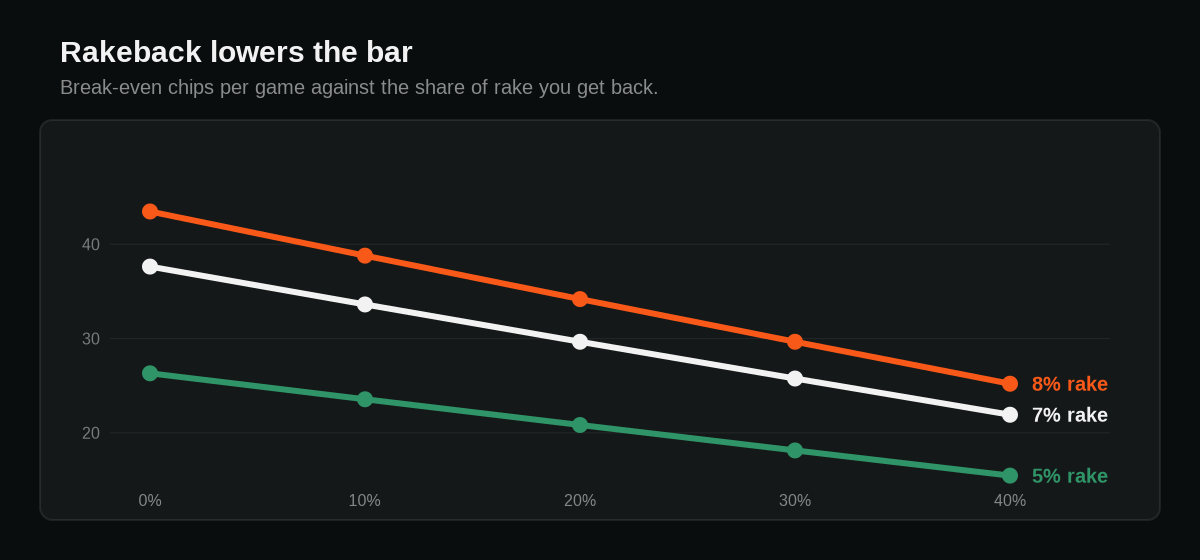
[PokerSciences](https://pokersciences.com/learn/spin/part-1/chapter-7) puts rakeback at 10% to 40% of the rake. At a 7% rake that takes the bar from 37.6 chips to between 33.6 and 21.9. Type your own rakeback into the [calculator](/spin-and-go-cev-calculator) to see where your bar lands.
## How speed changes the whole thing
A 300 chip game with a level every minute becomes push or fold sooner than a 500 chip game with a level every 3 minutes. I mean it's obvious. Which cuts the postflop decisions, which, shrinks your edge.
The real difference is the volume you need. In flash/turbo formats you'll only rely on your rakeback, trying to lost the minimum at the tables to win big win the rakeback.
When on the other side for classic formats you can beat the game and win pre-rakeback.
## Choose wisely.
```steps
scales | **Compute your effective rake.** Headline rake, minus the share you get back. Then the break-even chips for that stack. The [calculator](/spin-and-go-cev-calculator) does it for you.
lightning | **Check the clock and the stack.** A 300 chip game and a 500 chip game need different trees. Solve the one you play.
chart-line-up | **Play 1,000 games per room.** Compare cEV minus break-even, room by room, at the same buy-in.
crosshair | **Move volume to the best gap.** Edge is chips above the bar, not the room's reputation.
```
## FAQ
### Is the Winamax Expresso rake 7% or 8%?
7% for most buy-ins and 8% at €0.25 and €0.50, per Pokerfuse. In a normal sample, without the biggest jackpots, PokerSciences' €1 table works out to about 8.67%.
### Why do two rake numbers exist for one room?
Some sources divide the fee by the buy-in, others by the amount that goes into the prize pool. A $15 game with a $0.75 fee is 5% of the buy-in and 5.26% of the pool. This guide always uses the buy-in.
### Which room is best?
No public answer. Compare your own cEV against each room's break-even over at least 1,000 games, and keep your volume where the gap is the biggest.
Want to price your own preflop leaks against the bar? [Start free](/#pricing) (no card, ofc) and open the Trainer.
---
# Spin and Go cEV: how much you need to beat the rake?
URL: https://rangeviewr.com/blog/spin-and-go-cev
Published: 2026-10-20
Updated: 2026-11-05
**TL;DR**
- 500 chips starting stack with a 7% rake: you need +37.6 chips per game just to break even.
- 26 chips at 5%, 43 at 8%, 56 at 10%. And in reality you pay slightly more to poker sites 'cause the biggest jackpots almost never hit (ofc).
- Hourly profit = games per hour × chips above break-even × dollars per chip.
Spin and go cEV is what you must focus all your efforts on, not variance, not anything else. If you beat the rake, you win money, that's simple. Want your own numbers? Use the [Spin and Go cEV calculator](/spin-and-go-cev-calculator): pick your room, rake and rakeback, and it gives your break-even chips and ROI.
## The conversion: chips to ROI
Three players, 500 chips each, 1,500 in total. Let's call the rake ρ, what the room keeps. The average pool is 3 × buy-in × (1 − ρ), and your expected share of it follows your chips. That gives:
`ROI = (1 − ρ) × (1 + cEV / 500) − 1`
At a 7% rake, +1 chip moves ROI by 0.93 ÷ 500, so 0.186 points. Set ROI to zero and you get the break-even bar: `cEV = ρ × 500 ÷ (1 − ρ)`.
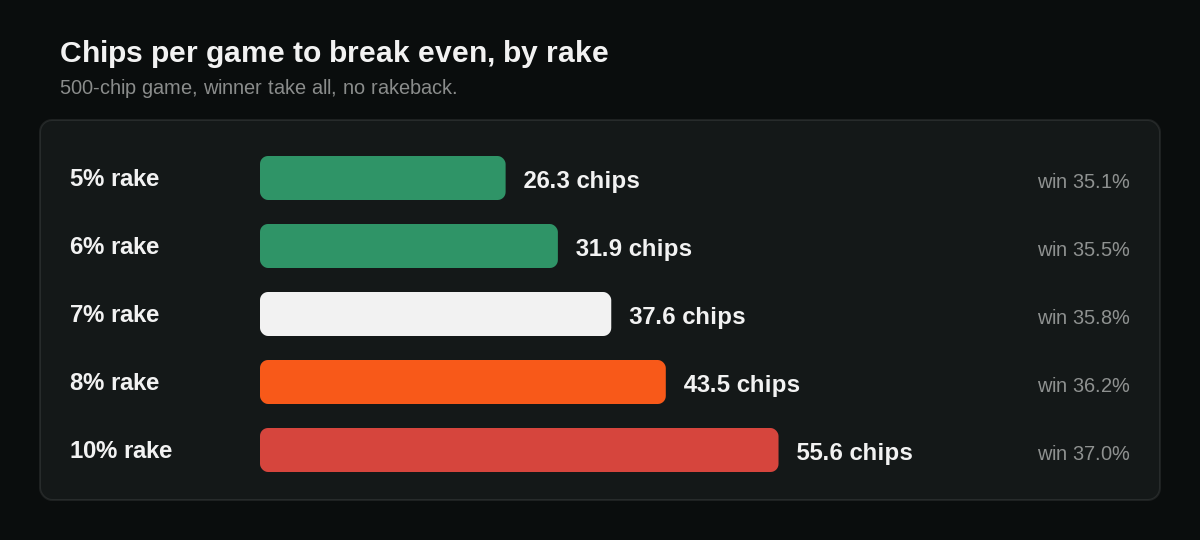
Equal players each win one game in three (33.3%). At a 7% rake you have to win 35.8% of your games to break even, and 37.0% at 10%. For 300 chip games (Nitro, Flash) it's the same rule with 300 instead of 500: a chip is worth 0.31 ROI points at 7%, and the bar is 22.6 chips. Same 7.5% of your starting stack, btw.
## The rake you actually pay
The rake take every jackpots into account. But in the reality you'll (almost) never hit the biggest ones, so you pay more. Let's take Pokerstars as an example. Its average multiplier is 2.76, which is a rake of exactly 8.00%. Leave out the 12,000x, 240x and 120x prizes, which show up together in about 106 games per million, and you pay 8.94%. The bar goes from 43.5 to 49.1 chips.
Same story at Winamax and Betclic: Take out the two biggest jackpots at Winamax (100,000x and 1,000x) and the biggest at Betclic (1,000x): Winamax's 7% becomes 8.67% (a bar of 47.4 chips, a 36.5% win rate) and Betclic's 7% becomes 7.17% (38.6 chips, 35.9%). Crazy no ? The [cEV calculator](/spin-and-go-cev-calculator) has an Effective switch for each of these rooms, so you can see your own bar at the rake you really pay.
## Rakeback
Rakeback adds `rakeback share × ρ` to your ROI and lowers the effective rake. At a 7% rake:
| Rakeback | Effective rake | Break-even | ROI added |
|---|---|---|---|
| 0% | 7.0% | 37.6 chips | 0.0 points |
| 10% | 6.3% | 33.6 chips | 0.7 points |
| 20% | 5.6% | 29.7 chips | 1.4 points |
| 30% | 4.9% | 25.8 chips | 2.1 points |
| 40% | 4.2% | 21.9 chips | 2.8 points |
So you must be certain to really crush your limit. Enter your own rakeback in the [calculator](/spin-and-go-cev-calculator) to see where your bar lands.
## Hourly rate
Dollars per chip is `buy-in × (1 − ρ) ÷ 500`. Profit per game is that times your chips above break-even, and volume does the rest. [PokerListings](https://www.pokerlistings.com/poker-strategies/sit-and-go/how-to-make-a-profit-playing-spin-and-gos-a-statistical-deep-dive) puts an average game at about 7 minutes, and five-tabling at about 40 games an hour.
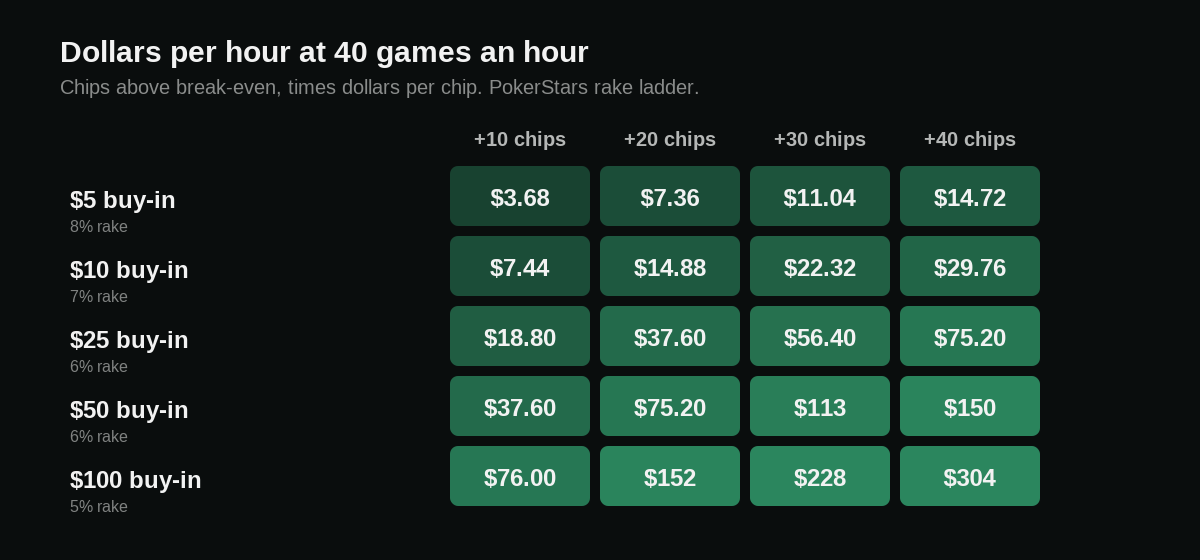
Here we used the PokerStars rake ladder from PokerNews: 8% up to $5, 7% at $10, 6% at $25 and $50, 5% from $100. Someone +20 chips over the bar earns about 3.7 points of ROI at any of these buy-ins.
## When to trust your cEV ?
cEV needs far fewer games than ROI, but still more than most players think. In the PokerSciences simulation for a player with a true cEV of 65, about 30% of players were in the red after 200 games and about 10% after 1,000. After 10,000, none. Multipliers make ROI even slower: PokerListings simulated 5% ROI players at $15 and after 10,000 games results ranged from +$760 to +$9,400 around an expected +$7,500. Same skill, wildly different outcomes. You can see this spread for your own cEV: the [calculator](/spin-and-go-cev-calculator) simulates up to 300 runs and shows how far luck can pull you from the expected line.
Bankroll follows the same logic. At $15, PokerListings gives 120 buy-ins for a 5% ROI, 300 for 2% and 600 for 1% (with a 5% risk of ruin)
## FAQ
### What is cEV in Spin and Go?
cEV is the average number of chips you win per game, with the luck of all-ins removed. It tracks your decisions, so it settles with far fewer games than ROI.
### What is a good cEV in Spin and Go?
Depends on the rake. At 7% you need +37.6 chips to break even, and about +54 for a 3% ROI. At 5% the bar drops to 26.3 chips.
### Why not just track ROI?
ROI is what you earn, but it carries the lottery of the multiplier. cEV tracks the quality of your decisions (and the card distribution too)
### Does rakeback change the math?
Yes. It lowers ρ in the same formula, so the break-even bar falls and your ROI rises by rakeback times rake.
Want to test out your preflop skills? [Start free](/#pricing) (no card needed).