
Spin and go cEV is what you must focus all your efforts on, not variance, not anything else. If you beat the rake, you win money, that's simple. Want your own numbers? Use the Spin and Go cEV calculator: pick your room, rake and rakeback, and it gives your break-even chips and ROI.
The conversion: chips to ROI
Three players, 500 chips each, 1,500 in total. Let's call the rake ρ, what the room keeps. The average pool is 3 × buy-in × (1 − ρ), and your expected share of it follows your chips. That gives:
ROI = (1 − ρ) × (1 + cEV / 500) − 1
At a 7% rake, +1 chip moves ROI by 0.93 ÷ 500, so 0.186 points. Set ROI to zero and you get the break-even bar: cEV = ρ × 500 ÷ (1 − ρ).
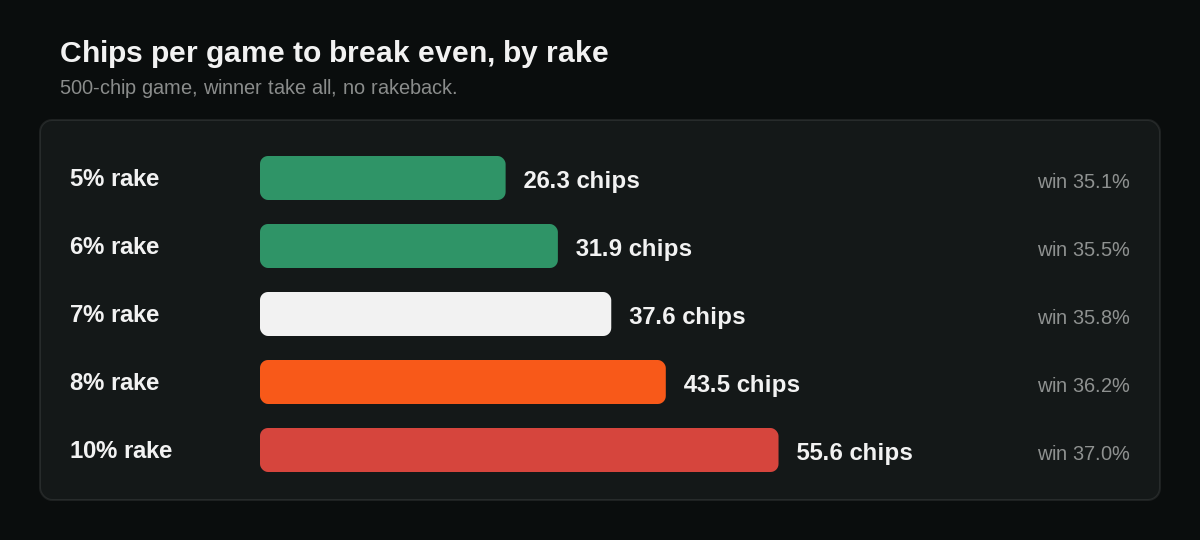
Equal players each win one game in three (33.3%). At a 7% rake you have to win 35.8% of your games to break even, and 37.0% at 10%. For 300 chip games (Nitro, Flash) it's the same rule with 300 instead of 500: a chip is worth 0.31 ROI points at 7%, and the bar is 22.6 chips. Same 7.5% of your starting stack, btw.
The rake you actually pay
The rake take every jackpots into account. But in the reality you'll (almost) never hit the biggest ones, so you pay more. Let's take Pokerstars as an example. Its average multiplier is 2.76, which is a rake of exactly 8.00%. Leave out the 12,000x, 240x and 120x prizes, which show up together in about 106 games per million, and you pay 8.94%. The bar goes from 43.5 to 49.1 chips.
Same story at Winamax and Betclic: Take out the two biggest jackpots at Winamax (100,000x and 1,000x) and the biggest at Betclic (1,000x): Winamax's 7% becomes 8.67% (a bar of 47.4 chips, a 36.5% win rate) and Betclic's 7% becomes 7.17% (38.6 chips, 35.9%). Crazy no ? The cEV calculator has an Effective switch for each of these rooms, so you can see your own bar at the rake you really pay.
Rakeback
Rakeback adds rakeback share × ρ to your ROI and lowers the effective rake. At a 7% rake:
| Rakeback | Effective rake | Break-even | ROI added |
|---|---|---|---|
| 0% | 7.0% | 37.6 chips | 0.0 points |
| 10% | 6.3% | 33.6 chips | 0.7 points |
| 20% | 5.6% | 29.7 chips | 1.4 points |
| 30% | 4.9% | 25.8 chips | 2.1 points |
| 40% | 4.2% | 21.9 chips | 2.8 points |
So you must be certain to really crush your limit. Enter your own rakeback in the calculator to see where your bar lands.
Hourly rate
Dollars per chip is buy-in × (1 − ρ) ÷ 500. Profit per game is that times your chips above break-even, and volume does the rest. PokerListings puts an average game at about 7 minutes, and five-tabling at about 40 games an hour.
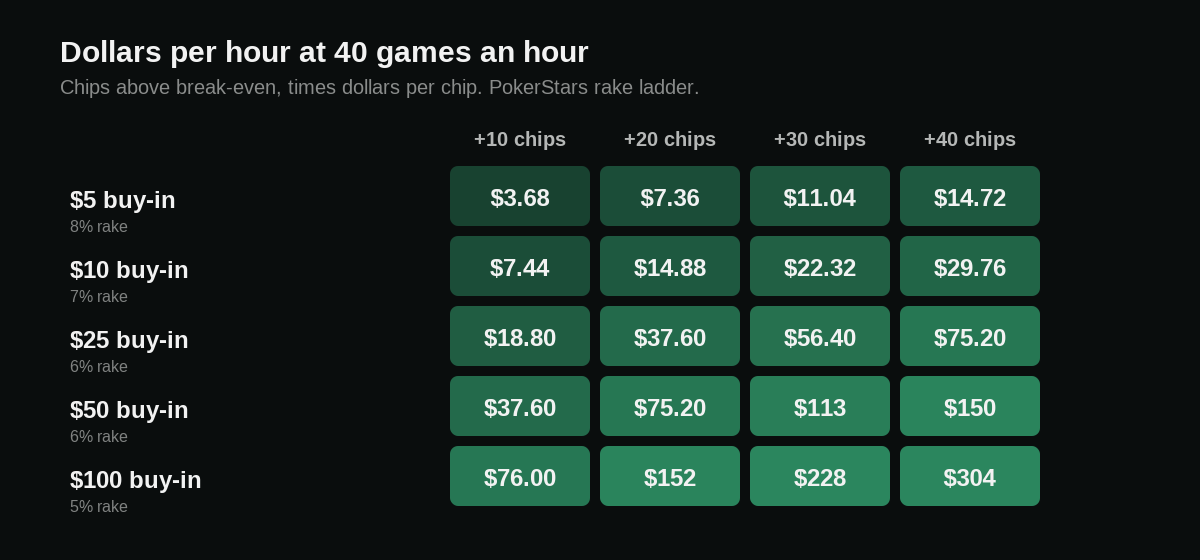
Here we used the PokerStars rake ladder from PokerNews: 8% up to $5, 7% at $10, 6% at $25 and $50, 5% from $100. Someone +20 chips over the bar earns about 3.7 points of ROI at any of these buy-ins.
When to trust your cEV ?
cEV needs far fewer games than ROI, but still more than most players think. In the PokerSciences simulation for a player with a true cEV of 65, about 30% of players were in the red after 200 games and about 10% after 1,000. After 10,000, none. Multipliers make ROI even slower: PokerListings simulated 5% ROI players at $15 and after 10,000 games results ranged from +$760 to +$9,400 around an expected +$7,500. Same skill, wildly different outcomes. You can see this spread for your own cEV: the calculator simulates up to 300 runs and shows how far luck can pull you from the expected line.
Bankroll follows the same logic. At $15, PokerListings gives 120 buy-ins for a 5% ROI, 300 for 2% and 600 for 1% (with a 5% risk of ruin)
FAQ
What is cEV in Spin and Go?
cEV is the average number of chips you win per game, with the luck of all-ins removed. It tracks your decisions, so it settles with far fewer games than ROI.
What is a good cEV in Spin and Go?
Depends on the rake. At 7% you need +37.6 chips to break even, and about +54 for a 3% ROI. At 5% the bar drops to 26.3 chips.
Why not just track ROI?
ROI is what you earn, but it carries the lottery of the multiplier. cEV tracks the quality of your decisions (and the card distribution too)
Does rakeback change the math?
Yes. It lowers ρ in the same formula, so the break-even bar falls and your ROI rises by rakeback times rake.
Want to test out your preflop skills? Start free (no card needed).