

Every Spin and Go ranges you'll find out there assume that the game ends after you played the hand. Which is fine at 25bb but pretty weird at 5bb deep. Like in a Turbo, 3-way format future game has a real impact. We solved both versions and put them side by side, so you can compare and see differences.
Each orbit costs a lot
Imagine, eacch orbit you lose 1.5bb and you play in a 3-way turbo format, how fast you think you'll blidn out?
| Your stack | Next big blind | Next full orbit |
|---|---|---|
| 25bb | 4% | 6% |
| 10bb | 10% | 15% |
| 7bb | 14% | 21% |
| 5bb | 20% | 30% |
| 4bb | 25% | 37.5% |
No matter what you'll hit the big blind next.
Now add the clock to that. PokerStars a level every 2 to 5 minutes. Winamax Expresso moves every 90 seconds. Fold at 5bb deep and you'll not keep them like classic ranges presume.
What FGS is, and who already has it
FGS is not new and we didn't invent it. PokerStrategy describes it as a look ahead that adds the value of future options. ICMIZER and HRC both compute it.
We found no public Spin and Go chart that uses a future game model, poker.academy and GTO Ranges+ included (checked November 2026).
So you have two choice - either solve it by yourself or take a look at Rangeviewr ones for free.
What our two sets model:
- Classic is a chip EV model. The hand ends.
- FGS is a future game simulation model with a winner take all prize. Accounting for depth 3, and depth 1 when three players are left.
Heads-up: it barely changes before 5bb
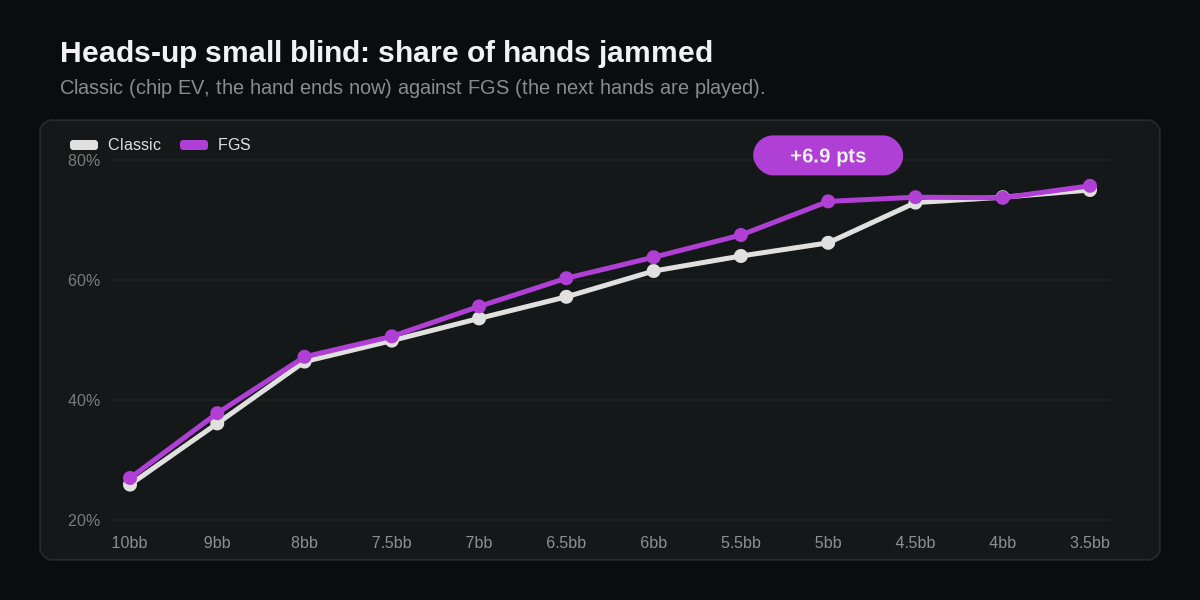
The heads-up small blind jams a bit more in FGS at nearly every depth, and most gaps are under 3.5 points. The big one is 5bb: 66.2% against 73.1%.
The caller barely reacts. The big blind's call against a jam stays within 0.6 points from 10bb down to 4.5bb, and only reaches 1.6 at 4bb.
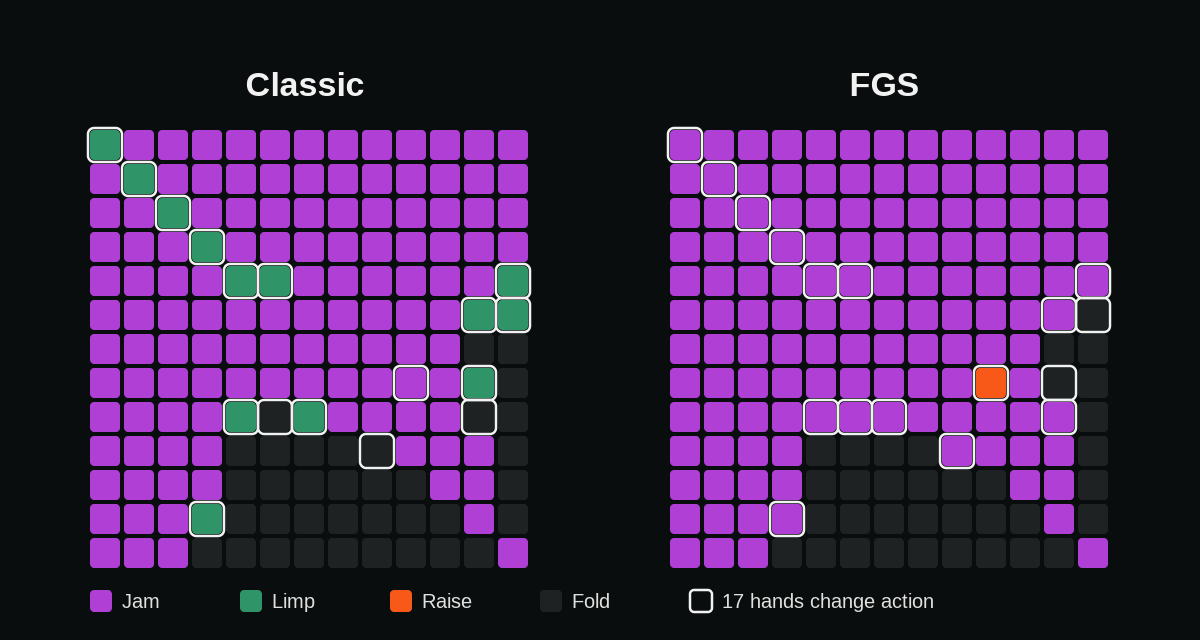
Same 5bb spot, hand by hand. Classic limps AA, KK, QQ, JJ and TT most of the time. FGS jams all of them. Part of that gap comes from the two trees using different bet sizes, so read the jam and call spots first and take the limp lines with a grain of salt.
Three-way: here come the real differences
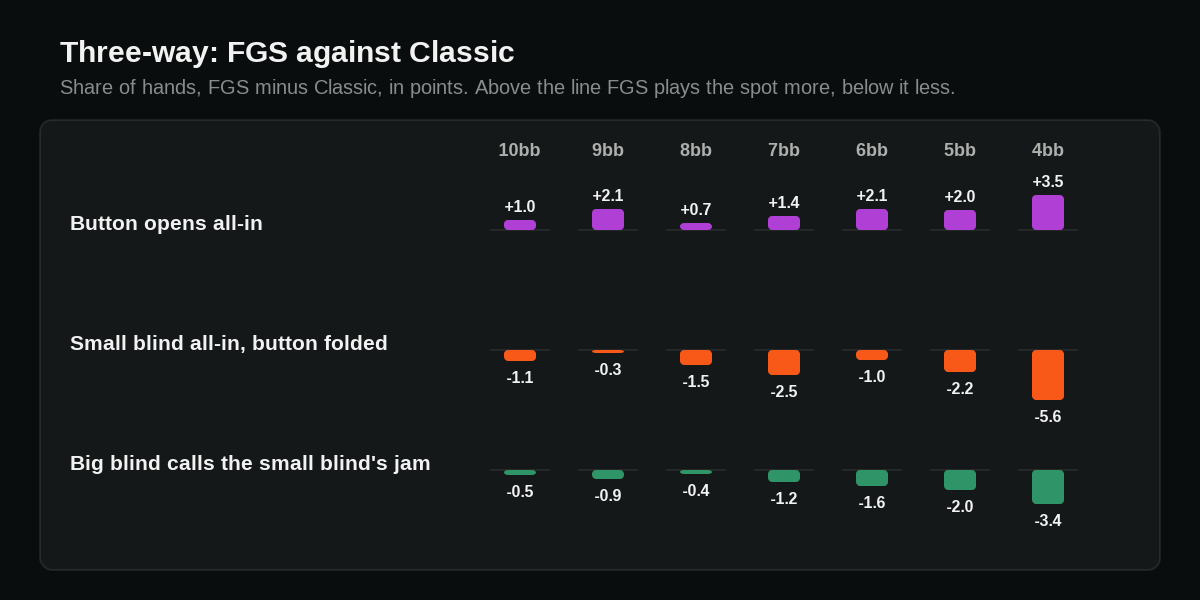
| 10bb Classic | 10bb FGS | 7bb Classic | 7bb FGS | 4bb Classic | 4bb FGS | |
|---|---|---|---|---|---|---|
| Button opens all-in | 27.3% | 28.3% | 36.8% | 38.2% | 42.0% | 45.5% |
| Small blind all-in, button folded | 43.7% | 42.6% | 59.7% | 57.2% | 72.8% | 67.2% |
| Big blind calls the small blind's jam | 36.7% | 36.2% | 48.1% | 46.9% | 70.7% | 67.3% |
As stacks shrink, the button jams more while the small blind jams less and the big blind calls less. One fixed "short stack" adjustment gets at least one of these seats wrong. (that's the punt.)
The real imapct occurs below 10bb
This is where each blind has a real impact on your stack.
That's why our FGS library stops at 10bb. We haven't implemented FGS ranegs above that 'cause they were urelevant. The logic is simple though: at 25bb the next big blind is 4% of your stack, and there's not much future cost.
How to use it
Open the same spot in both. In the Library, switch between Classic and FGS.
Look for differences. It occurs on your range's bottom.
Implement in game That's where you'll earn some EV.
Skip it above 10bb. Use chip EV there and spend your study time on drills.
FAQ
Is FGS the same as ICM?
No. ICM turns chips into prize money from the current stacks. FGS also plays out the next hands. Most Spins are winner take all, so ICM changes little there. The future hands still matter, because blinds and position keep moving.
Should I throw out my chip EV ranges?
No. Above 10bb the two sets are close, and chip EV is simpler to solve and to learn. Below 10bb, keep it as your base and study the hands that change.
Do the FGS ranges change my results?
We don't know yet. We showed the ranges differ, not that playing them wins more. Your own cEV over a big sample, against the break-even for your rake, is the only honest test.
Want to see every spot side by side? Start free (no card, ofc) and open the Library. FGS depths are part of Pro.